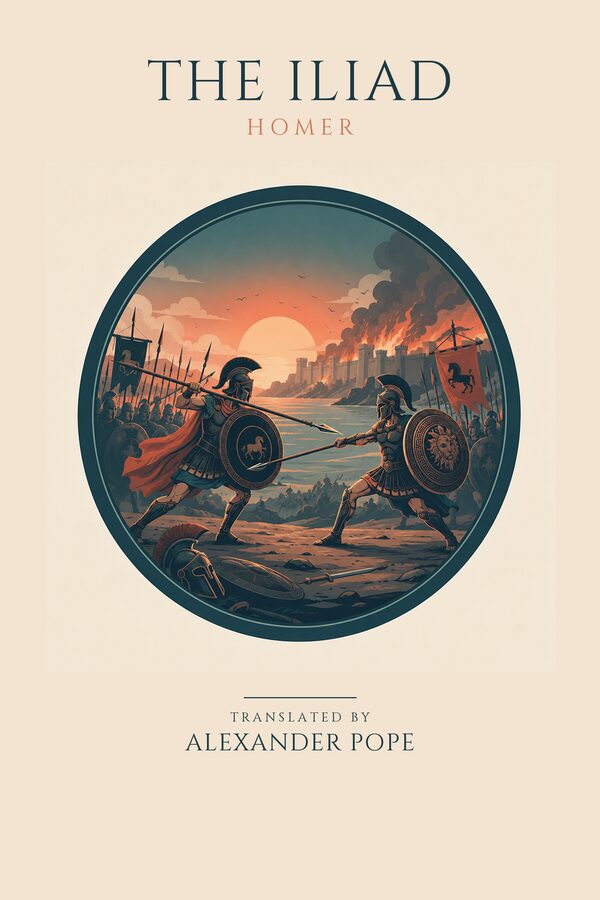
Alexander Pope's Iliad
“Achilles' wrath, to Greece the direful spring / Of woes unnumber'd, heavenly goddess, sing!”
About this edition
About This Translation
Alexander Pope's Iliad, issued in six volumes between 1715 and 1720, is the most famous verse translation of Homer in the English language. Pope rendered the poem into heroic couplets — closed, rhymed pairs of iambic pentameter lines — the reigning form of English poetry in his age, and he did it so brilliantly that the work made him the first English poet able to live independently on what his writing earned. The subscription list read like a roll call of the nation.
The Age That Made It
This is Homer in the dress of the English Augustan age — an age that prized polish, proportion, wit, and the well-turned line. Pope's couplets are balanced and epigrammatic, forever closing a thought with a click; the battlefield becomes a stage for sonorous, ordered grandeur. It is a magnificent performance, and unmistakably of its century: the great scholar Richard Bentley is said to have told him, "It is a pretty poem, Mr. Pope, but you must not call it Homer."
What's Distinctive, and What's Contested
Bentley's barb names the real debate. As English poetry, Pope's Iliad is a masterpiece — inventive, powerful, endlessly quotable. As a mirror of Homer, it is the freest of the major translations: it smooths the Greek's ruggedness, adds ornament Homer never wrote, and turns his plain force into Augustan elegance. Read it for the glory of the English, not for a transparent window onto the Greek. On that understanding, few reading experiences in the language are grander.
How This Version Reads
Expect stately, rhymed, formal verse of great momentum and music — a monument you can hear. It rewards readers who love English poetry and don't mind an eighteenth-century voice between them and Troy. For a first, plot-focused read, a modern version or a free prose edition will move faster; for sheer grandeur, nothing free surpasses it.
Download this translation — free
Public domain · EPUB works on Kindle, Apple Books & Kobo. No registration.
EPUB opens in Apple Books, Kobo & most readers. For Kindle, use Amazon's free Send to Kindle — it accepts EPUB too.
At a glance
- Translator
- Alexander Pope (1688–1744)
- Published
- 1715–1720
- Form
- Rhymed verse (heroic couplets)
- Reads like
- Grand, formal, musical — a monument of English verse
- Rights
- Public domain — free to download and keep
Compare other translations
Ready to read Alexander Pope?
Free public-domain download — EPUB works on Kindle, Apple Books & Kobo.